
LONG LIFE · VIBRO-ACOUSTIC PRACTICE
SUSHUMNA™A chair for raising kundalini
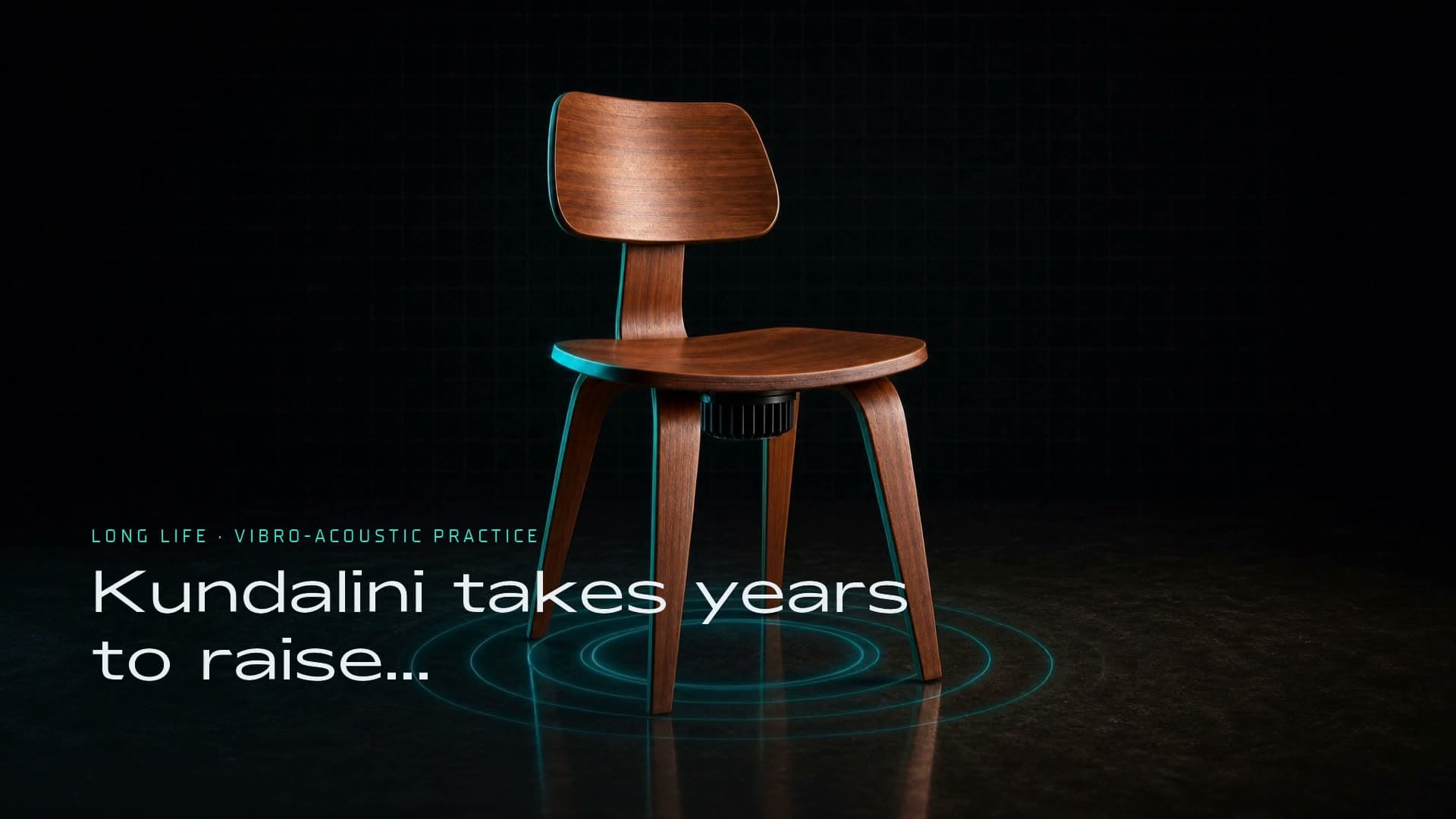
Low-frequency vibration travels through the seat straight into the base of the spine — where, according to yoga tradition, kundalini lies dormant. You sit down with your spine straight, start a program — and the practice begins.
- Two vibro-acoustic drivers
- Molded plywood, walnut
- Smartphone control

Promo film · 73 seconds
Kundalini takes years to raise. See what the chair changes.
Four paths that never reach the body. Two drivers — under the seat and on the backrest. The pulse rising from the seat to the crown — and why seated, not lying down. With sound.
There are four ways to raise kundalini. Each has a ceiling.
Years of practice
Mula bandha, pranayama, kriyas. It works — but it takes years of daily discipline and a teacher at hand. Most people give up before they feel anything.
Sound baths
Bowls and gongs travel through the air. Everything reaches the ears; almost nothing reaches the base of the spine — air is a poor carrier of vibration into the body.
Binaural beats
Headphones work with hearing and the brain, not with the body. The point where kundalini begins stays untouched.
Massage chairs and vibrating loungers
There is vibration, but it is massage: broad, lying down, with no chosen frequency. No focus on the base of the spine, no straight back.
The first three never reach the body. The fourth does — but not the right place.SUSHUMNA delivers vibration of the right frequency to the base of the spine and along it — in the posture kundalini has been raised in for thousands of years.
Sound you hear stays outside.SUSHUMNA passes it to the body.
Under the seat and on the backrest sit two tactile low-frequency drivers. They do not play sound into the air — they turn it into mechanical vibration: the lower one sends it through the seat into the pelvis, sacrum and tailbone, the upper one through the backrest along the spine. What tradition calls muladhara, you feel physically — from the first minute.
How a session goes
Sit down
Feet on the floor, spine straight, palms on your thighs. The chair is shaped so that a straight back holds itself without effort.
Choose a program
From your smartphone. The programs are recorded at low frequencies: you feel them more than you hear them.
Feel the point
Within a minute or two, attention gathers at the base of the spine by itself. Mula bandha teaches you to hold it there by effort — here the point itself calls attention in.
Twenty minutes
Then breathe or meditate the way you are used to. The chair holds the focus; you hold the attention.
Three parts that make the chair an instrument
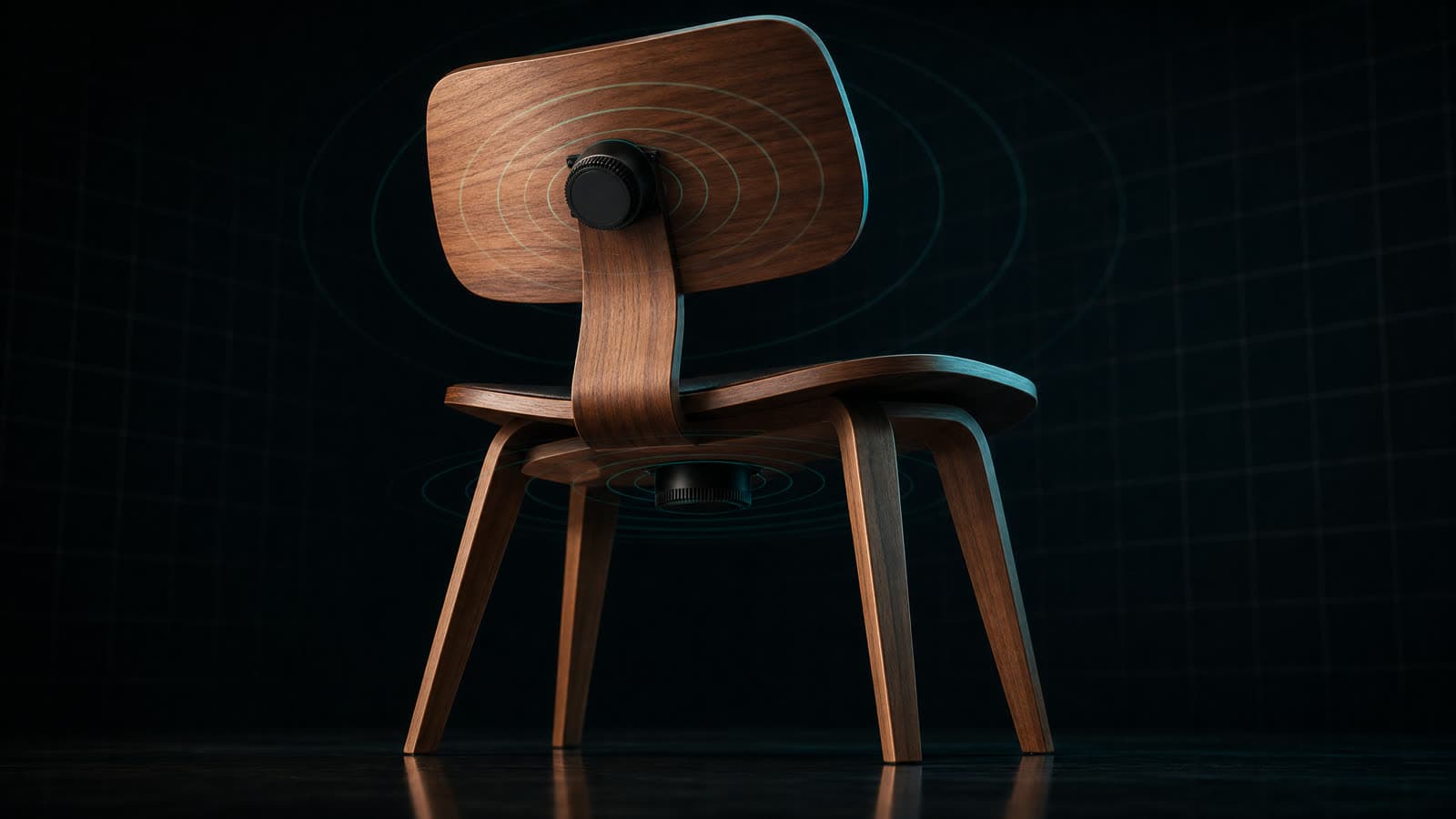
Two drivers
Two tactile low-frequency transducers: one under the seat, one on the backrest. Not speakers: they have no cone and produce no audible sound. They move mass — and pass the oscillation through their mounts to the seat and the backrest: into the base of the spine and along it.
The resonator
Molded plywood. Wood is a soundboard: like a guitar body, it spreads the vibration evenly across the whole seat, with no hot spot above the drivers. Plastic damps, metal rings. Plywood resonates.
The programs
The sound layer. Each program is a composition of low frequencies with a set dynamic: rise, plateau, release. An amplifier with an equalizer tunes the output to your weight and posture.
Seated, not lying down. That is not design — it is the method.
Every vibro-acoustic lounger and chair lays you down: it is easier to relax that way. But kundalini is not raised lying down. In every tradition the practice is done with a straight spine: the channel the energy rises through has to be vertical.
SUSHUMNA is a chair without armrests and with a molded backrest. The spine is straight, the pelvis is stable, the vibration travels upward along the axis.
Hence the name. Sushumna is the central channel along the spine through which, according to tradition, kundalini rises from the base to the crown.

What is known about low-frequency vibration
Vibroacoustic therapy (VAT) is a field developed in the 1980s by the Norwegian educator and therapist Olav Skille: sinusoidal vibrations of 30–120 Hz are delivered to the body through transducers built into a bed or chair. The first clinical description of the method was published in 1989 (Skille, Wigram, Weekes — Journal of British Music Therapy).
Over forty years a research field has grown around VAT. Studies most often use 30–40 Hz, sessions last 20–45 minutes, and the most studied frequency is 40 Hz (Clements-Cortes et al., 2016; Bartel et al., 2017).
The body reads such vibration not by hearing but through the mechanoreceptors of the skin and deep tissue: Pacinian corpuscles respond to vibration from roughly 20 to 1000 Hz, Meissner corpuscles from 10 to 50 Hz. That is why low frequencies coming through the seat feel like a physical presence rather than a sound.
We describe the mechanism of vibration transfer and the history of the method, not a therapeutic effect. SUSHUMNA is not a medical device. VAT studies were carried out on other devices under other conditions and do not transfer to the chair automatically.
30–120 Hz
the vibroacoustic therapy range according to Skille
40 Hz
the most studied frequency in VAT research
20–45 min
typical session length in the studies
Sources
- Skille O., Wigram T., Weekes L. Vibroacoustic Therapy: The Therapeutic Effect of Low Frequency Sound on Specific Physical Disorders and Disabilities. Journal of British Music Therapy, 1989, 3(2), 6–10
- Clements-Cortes A. et al., 2016. doi:10.3233/JAD-160081
- Bartel L. R., Chen R., Alain C., Ross B. Vibroacoustic Stimulation and Brain Oscillation: From Basic Research to Clinical Application. Music and Medicine, 2017, 9(3), 153–166
What tradition says — and where the chair fits in
Kundalini is Sanskrit for “coiled”. According to tantric texts and the 15th-century Hatha Yoga Pradipika, this energy rests at the base of the spine, in muladhara — the “root support” — and rises through the central channel, sushumna.
The first technique a practitioner is taught is mula bandha, the “root lock”: holding attention and a gentle contraction in the perineum and the base of the spine. For years. That is exactly the point the chair delivers vibration to.
The chair does not replace practice. It gives it a point of support.
Programs
Each program has its own frequency, its own dynamic and its own purpose. Choose from your smartphone with a single tap.
Program 01
Program 02
Program 03
Program 04
Who it is for
Practitioners
Kundalini yoga, meditation, pranayama. A daily instrument that makes the practice tangible from the first session — not after years.
LONG LIFE program clients
As part of a recovery protocol: a session on the chair pairs with the breathing practices led by the founder.
Studios and retreat centers
The chair as a service for your clients: a 20-minute session nobody nearby offers. Terms on request.
What it looks like


Specifications
- Body
- molded plywood, walnut veneer
- Drivers
- 2 tactile low-frequency transducers: under the seat and on the backrest
Comparing the approaches
| Practice without an instrument | Sound bath | Binaural app | Vibrating lounger / massage chair | SUSHUMNA | |
|---|---|---|---|---|---|
| Where the vibration goes | — | Into the air, through hearing | Into headphones, through hearing | Into the body, broadly, lying down | Into the body: at the base of the spine and along it |
| Frequencies | — | The instrument’s spectrum | Audible + binaural | Massage, not selectable | Low, set by the program |
| Posture | Seated, spine straight | Lying down | Any | Lying / reclining | Seated, spine straight |
| Focus on the base of the spine | By effort, over years | No | No | No | From the first minute |
| Experience needed | Yes, and a teacher | No | No | No | No |
| Time until you feel it | Months to years | — | — | At once, like a massage | 1–2 minutes |
Questions and answers
SUSHUMNA is a chair for the practice of raising kundalini. Under the seat and on the backrest of molded plywood sit two tactile low-frequency drivers that deliver vibration of a set frequency to the base of the spine and along it. A session lasts about 20 minutes, is done seated with a straight spine and is controlled from a smartphone. The chair was developed by the LONG LIFE research and design bureau.
In three ways. The vibration is not chaotic like a massage — it follows the axis: into the base of the spine and along it, from two drivers. The frequencies are not massage frequencies but low ones, set by the program. And you sit with a straight spine instead of lying down: in every tradition, the practice of raising kundalini is done with a vertical spine.
Within a minute or two — a distinct vibration in the pelvis and at the base of the spine. From there the sensations are individual: warmth, pulsing, a movement up the back, deep calm. We do not promise any specific experience — the chair gives you the point; what you do with it is up to your practice.
No. The first sessions are simply sitting and breathing. For experienced practitioners the chair gives what they spent years working toward with mula bandha: attention at the base of the spine without effort.
The vibration is low-intensity, comparable to household massage devices. If in doubt, ask your doctor before the first session.
A session is about 20 minutes. Start with 2–3 sessions a week, then go by how you feel and by your practice.
No. SUSHUMNA is a household device for practice and relaxation. It is not a medical device and is not intended to diagnose, prevent or treat any disease.
Yes, and we recommend it. A session on the chair pairs well with the breathing practice led by the founder of LONG LIFE: the chair holds the focus at the base of the spine, the breath leads attention upward.
Sit down — and feel it
A trial session is 20 minutes at the LONG LIFE studio. No obligation: you simply sit down and within two minutes you know whether this is for you.
We reply on WhatsApp and TelegramWhatsAppTelegram
For studios and retreat centers — write to us and we will discuss the format
SUSHUMNA™ is a household device for practice and relaxation. It is not a medical device and is not intended to diagnose, prevent or treat any disease. Descriptions of traditions are given in a cultural and educational context. The materials on this page are for information purposes.
Updated: